
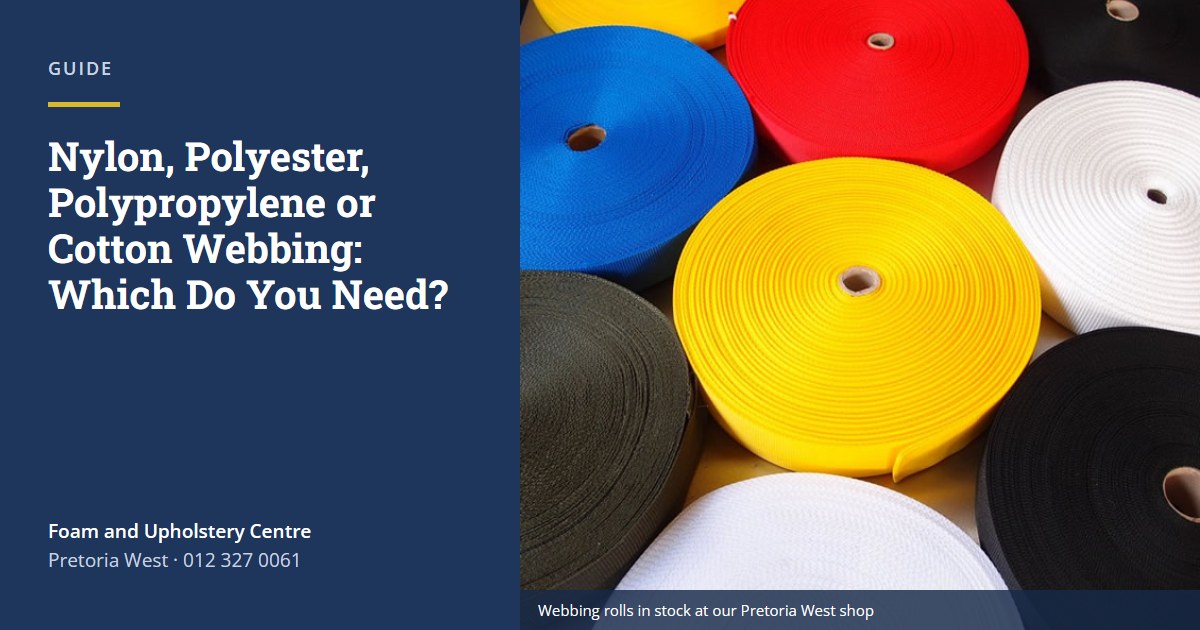
On the roll, most webbing material looks much the same: a flat, woven strap in a colour and a width. In use, the fibre it is made from makes a big difference. Some webbing stretches, some does not; some shrugs off sun and rain, and some rots if it stays wet.
This guide compares the four most common webbing materials so you can choose the right strap for bags, tie-downs, covers, outdoor furniture and vehicle work. We stock all four, plus elastic webbing, sold by the metre or in 50m and 100m rolls: see our webbing supplier page.
Quick comparison
| Material | Strength | Stretch | Sun and water | Typical uses |
|---|---|---|---|---|
| Nylon | Very high | Some stretch | Absorbs water; UV resistance is moderate | Pet collars and leads, backpack straps, climbing-style gear |
| Polyester | High | Very little | Good UV and water resistance | Ratchet and cam buckle straps, outdoor covers, seatbelt-style straps |
| Polypropylene | Moderate | Little | Does not absorb water, but fades and weakens in strong sun unless UV-treated | Bag handles, light straps, budget projects |
| Cotton | Moderate | Little | Absorbs water; can rot or mould if left damp | Bags, belts, handles, decor and craft work |
Nylon webbing
Webbing material like Nylon is strong, smooth and hard-wearing, with a little give that absorbs shock. That stretch is useful for straps that are carried or worn, but less ideal where you need a strap to stay tight. Nylon absorbs some water and loses a little strength while wet, and long exposure to sun slowly weakens it.
Polyester webbing
Polyester is the usual choice for outdoor work and load securing. It is strong, stretches very little, and resists sun and water better than nylon, so a strap stays tight once it is cinched down. Ratchet straps, cam buckle straps and seatbelt webbing are typically polyester. We stock 50mm black seatbelt webbing, along with cam buckles and ratchets.
Polypropylene webbing
Polypropylene is light, cheap, comes in many colours and does not absorb water, so it dries quickly. It is not as strong as nylon or polyester and can fade and turn brittle in strong South African sun unless it is UV-stabilised. It is a good choice for bag handles and light-duty straps, not for heavy loads.
Cotton webbing
Cotton webbing is soft, comfortable to hold and has a natural, matt look, which is why it is popular for canvas bags, belts, handles and craft projects. It is weaker than synthetic webbing and absorbs water, so it can mould or rot if it is left damp. Keep it for items that are used indoors or dry out between uses.
What about elastic upholstery webbing?
Furniture uses its own kind of webbing: elastic rubber webbing for modern sofa and chair seats, or woven webbing for traditional sprung seats. See our guide on how to replace upholstery webbing.
Choosing the right width
Webbing material such as 25mm webbing suits bag straps, light tie-downs and most cam buckles; 50mm is used for heavier straps, seatbelt-style webbing and larger ratchets. Match the webbing width to the buckle, slide or ratchet you plan to use, because fittings are sized by webbing width. Our webbing comes in 10mm, 15mm, 20mm, 25mm, 30mm, 38mm, 50mm, 70mm, 90mm, 100mm and 300mm widths. We stock fittings including cam buckles, ratchets, D-rings, tri-glides, ladder locks and carabiner hooks.
A note on strength and safety
For lifting or securing loads on a vehicle, use straps with a stated breaking strength or lashing capacity, and stay well within it. Do not use unrated webbing for lifting people or loads overhead.
Need webbing or a custom strap?
We supply webbing material and fittings from our shop at 271 Charlotte Maxeke Street, Pretoria West, and we sew custom straps to your specifications, with buckles, ratchets or both attached. Request a quotation or call 012 327 0061.