
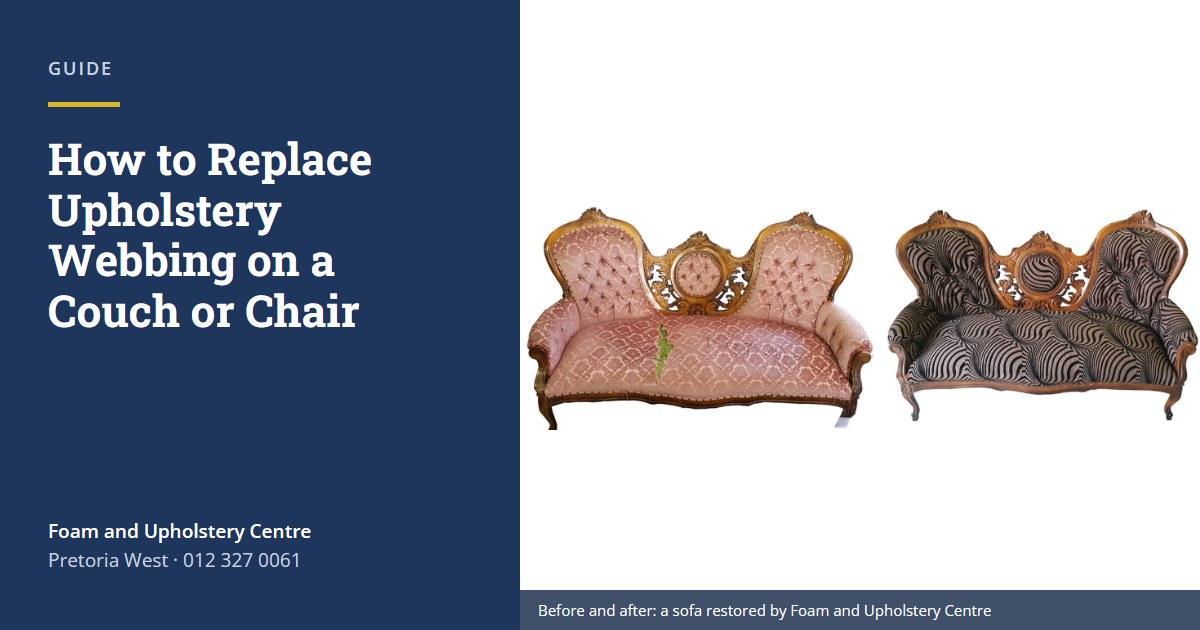
If your couch or chair seat sags, feels uneven, or you can feel the frame when you sit down, the webbing underneath has usually stretched or snapped. Replacing it is one of the most worthwhile repairs you can do on upholstered furniture: the frame and fabric are often still good, and new webbing brings the support back.
This guide explains the two main types of upholstery webbing, what you need, and how to replace it yourself. If you would rather not, bring the piece to us in Pretoria West and we will re-web it in our own workshop.
Signs your furniture webbing needs replacing
- The seat sags in the middle or on one side.
- The cushion sinks further than it used to, or feels uneven.
- You can see loose or broken straps when you look under the seat.
- The webbing has lost its stretch and no longer springs back.
Elastic or woven webbing: which one does your furniture use?
Elastic (rubber) webbing is the most common choice for modern sofas and chairs. It is fixed across the seat or back frame under tension and gives flexible support on its own, without springs. It lasts well and is the easiest type to replace at home.
Woven webbing (traditionally jute) is used in older and traditional upholstery. The straps are interwoven in a basket pattern across the frame and usually carry springs or stuffing on top. Re-webbing a traditional sprung seat is a bigger job, because the springs have to be re-tied as well.
Turn the chair over or take off the dust cover underneath, and you will see which type you have.
What you need
- New upholstery webbing of the same type and width as the old straps. We sell 50mm elastic upholstery webbing by the metre or by the roll (see our webbing range).
- A heavy-duty staple gun and staples, or upholstery tacks and a tack hammer
- Webbing clips, if the frame has grooves or slots for clipped webbing (we stock these too)
- A staple remover or flat screwdriver, and pliers
- A tape measure, chalk and sharp scissors
- A webbing stretcher, if you are fitting woven webbing
Step by step: replacing elastic webbing
- Remove the cushions and the dust cover. Turn the piece over and carefully lift the black cloth on the bottom so you can put it back later.
- Photograph and measure the old webbing. Note how many straps there are, which direction they run, the gaps between them, and how they are fixed (staples, tacks or clips).
- Take off the old straps. Remove the staples or clips and pull the old webbing out. Clean up any staples left in the wood.
- Check the frame. Look for loose joints, cracks or split rails. Glue and clamp loose joints before fitting new webbing, otherwise the frame will keep moving.
- Fix the first end. Staple or clip one end of the webbing to the back or side rail, using several staples across the width of the strap.
- Stretch and fix the other end. Pull the webbing across the frame to the opposite rail. It should be firm but not stretched to its limit. A common rule is to stretch elastic webbing by about 10 percent of its length for seats, and a little less for backs. Fix it, then trim the excess.
- Repeat for the remaining straps. Keep the tension and the gaps even, roughly one strap width apart. Some seats also have cross straps woven through in the other direction.
- Refit the dust cover and cushions. Sit on it, check that the seat feels even, and re-fix any strap that feels slacker than the rest.
Replacing woven webbing on a sprung seat
Woven webbing is fitted in the same order, but each strap is pulled tight with a webbing stretcher before it is tacked, and the straps are woven over and under each other. If the seat has springs, they need to be stitched to the new webbing and re-tied before the stuffing and fabric go back on. For antique or sprung pieces, it is often worth getting a quote first.
Replace the foam while the seat is open
If the seat foam has gone flat or crumbly, now is the time to replace it. We supply foam in various thicknesses and densities, and we cut it to any size. Read more about our canvas, webbing and upholstery services.
Need webbing or a hand with the job?
Visit our shop at 271 Charlotte Maxeke Street, Pretoria West, bring a piece of the old webbing so we can match it, bring the chair or couch in for us to re-web, or request a quotation. You can also call us on 012 327 0061.
Not sure which strap material you need for other projects? See our guide: Nylon, polyester, polypropylene or cotton webbing.